Broadway police chief lives his life in uniform, from Marine Corps to law enforcement
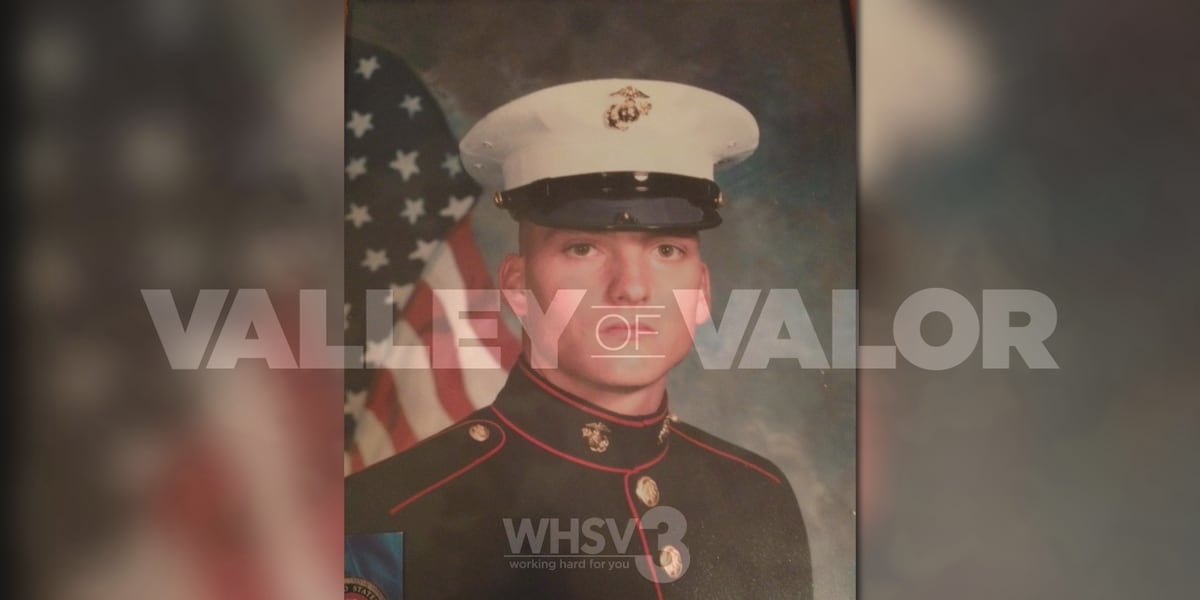
BROADWAY, Va. (WHSV) – Growing up in Quicksburg, J.D. Weaver spent most of his time playing “military” with his childhood friends. At 8 years old, the path ahead of him was clear.
“We had all the gear, the helmets, the play rifles and stuff,” Weaver said. “I told my mother at an early age, I’m going to be a Marine one day. I said, ‘I’m going to be a Marine, then I’m going to become a police officer.’ So, I basically lived my dream.”
Weaver, a U.S. Marine Corps veteran, is continuing to live out that dream as Broadway’s chief of police. His career led him down many paths before accepting the job in January 2025.
He graduated from Stonewall Jackson High School in 1990, but took a small gap to “appease an ex-girlfriend.” He eventually made his way to a recruiter, first with the Army and then with the Marine Corps.
“He had these cards and one said courage. He threw it down, and he looked at it and he said, ‘Do you have that?’ and I said, ‘Yeah, I have courage,’” Weaver recalled. “He threw another one down and said, ‘Integrity, you got integrity?” I said ‘Yes, sir.’ Then another one — honor. He said ‘Do you have that?’ I said ‘Yes, sir.’”
The recruiter told Weaver “he could definitely be a Marine,” so that’s what he became.
“Best thing I ever did in my life,” Weaver said. “I really needed that structure, and that’s why I tell young people to go in the military. It’ll give you structure and discipline that you’ll never have, which is important today because a lot of kids don’t get that at home.”
Weaver said he was “the class clown” and gave his teachers “a lot of grief.”
“I didn’t get in any trouble, but I had a bad attitude in school and my teachers — God bless them, I love every one of them — they put up with me and my shenanigans,” he said.
He completed boot camp at Parris Island, South Carolina, and said he felt something in him shift by the time he graduated.
“I think it changed my life forever — and it really did,“ Weaver said. ”The Marines’ motto is ‘the change is forever.’”
Weaver spent time in Camp Lejeune, North Carolina, Camp Pendleton, California, and Twentynine Palms, California, in the combat engineer battalion. While in service, Weaver taught military operations in urban terrain for the School of Infantry. At the end of his contract, Weaver said, he decided to leave the Marine Corps to prioritize his family.
“Once a Marine, always a Marine, right? Part of me always thought, ‘man, it would have been great to stay in,’” Weaver said. “Everything happens for a reason. I mean, I could have went to Afghanistan and got killed. Maybe it was God’s purpose for me to get out. Maybe I helped someone that needed help in D.C. or Harrisonburg or here.”
Weaver completed the police academy in 1996. As he made the transition into law enforcement, he said there were a lot of similarities but also a lot to unlearn from his military experience.
“The military is training to annihilate the enemy and kill them. That’s what they’re trained to do every day,” he said. “So when you cross over to the police department, you have to think you’re not in that role anymore. You’re kind of a savior. You’re trying to save people. Veterans are warriors and the police departments are guardians, [but] sometimes we have to put on our warrior face, because people are violent.”
Weaver’s first big job out of the military was as the chief of police in Edinburg. He then decided to take a job with the Washington D.C. Metropolitan Police Department.
He had to attend another police academy and graduated top of his class in PT. He said it was an experience similar to boot camp — a tactic to prepare trainees for working in the inner city.
“They had the bad projects, they had the heroin-infested projects, they had the crack cocaine issues. Then you could go two streets over and then see people touring the Capitol … and then the mall,” Weaver said. “I just had this crazy career.”
He served with the department for 22 years, making the commute from Strasburg to D.C. just about every day. During that time, Weaver got a front row seat to major historical events in the city.
“I was there when the D.C. Snipers were in the area. I was there for 9/11. I was there for all the riots that we had, the IMF protest, Black Lives Matter, Antifa riots, the January 6th riots and then the Navy Yard massacre,” he recalled.
On 9/11, Weaver was taking a theft report at CNN’s newsroom. Surrounded by televisions with his notepad in hand, he watched the planes hit the Twin Towers.
Immediately, he was sent to the White House to help with evacuations.
“I’m directing traffic, pulling everybody out, then the plane hit the Pentagon. Basically, you heard the explosion and the flames came up,” Weaver said.
Though not a combat veteran, he said he was the frontlines to “war zones” on the home front. Two years in, his partner was shot in the head during a gang-related call, but thankfully survived. By the end, Weaver had handled over 1,000 homicides.
“You’ll go into work, you’ll have a homicide that night — normal thing. You’re going to work, you hear gunshots around the block and you pull around to kind of try to find the gunshots, because that’s what police officers and military veterans do. We run to the gunfire while everybody else is running away, right? And so you’ll find somebody that’s been shot several times,” he said. “I tell everybody around here [in the Valley], we’re really lucky we don’t have crime like that, a lot of things that other people should never see. Same with veterans.”
Weaver said working out was always his favorite way to cope, but he now occasionally meets with a professional when needed. In his current position, he instructs all of his officers to do the same after intense situations.
“You hurt so much inside seeing people get hurt all the time that you almost have to become desensitized to deal with it. You have this box inside of you, and then it’ll fill up, and then it’ll overflow,” Weaver said. “Once it starts overflowing, that’s bad, you know? You can’t keep putting things away, you gotta get it out. Help is out there for PTSD, for veterans and police officers.”
After reluctantly handing over his retirement papers in D.C., he said, he spent three years with the Harrisonburg Police Department before taking the job in Broadway.
He said his top priorities are to provide his officers with as many training opportunities as possible, operate an office of transparency and build stronger connections within the community.
“You know, police officers, your job in law enforcement isn’t about locking everybody up,” Weaver said. “It’s about reaching the ones that are reachable and trying to make a difference in their life.”
Weaver now lives in New Market and no longer makes a four-hour round-trip commute to and from work. He takes great pride in his seven children, wife and cats. His oldest son followed in his footsteps as a Marine, something Weaver said he is very proud of.
He said he is blessed to serve the community, as he’s “always been a Valley boy.”
“It has its crime, like every little town. For the most part, we have a great town and a great community, and I’m humbled to be here, I really am,” Weaver said. “Every day is a great day here.”
Copyright 2025 WHSV. All rights reserved.
link